Most freelancers don’t notice the biggest Payoneer fee — because it doesn’t appear as a “fee”.
Instead, it’s built into the exchange rate.
This guide explains how the Payoneer exchange rate compares to the real market rate, how much you actually lose on currency conversion, and what you can do to reduce those losses.
What is the “real” exchange rate?
The real exchange rate (also called the mid-market rate) is the rate you see on financial data platforms and currency trackers. It’s the midpoint between buy and sell prices in global markets.
Financial institutions rarely give you this rate directly. Instead, they add a markup.
Does Payoneer use the real exchange rate?
No.
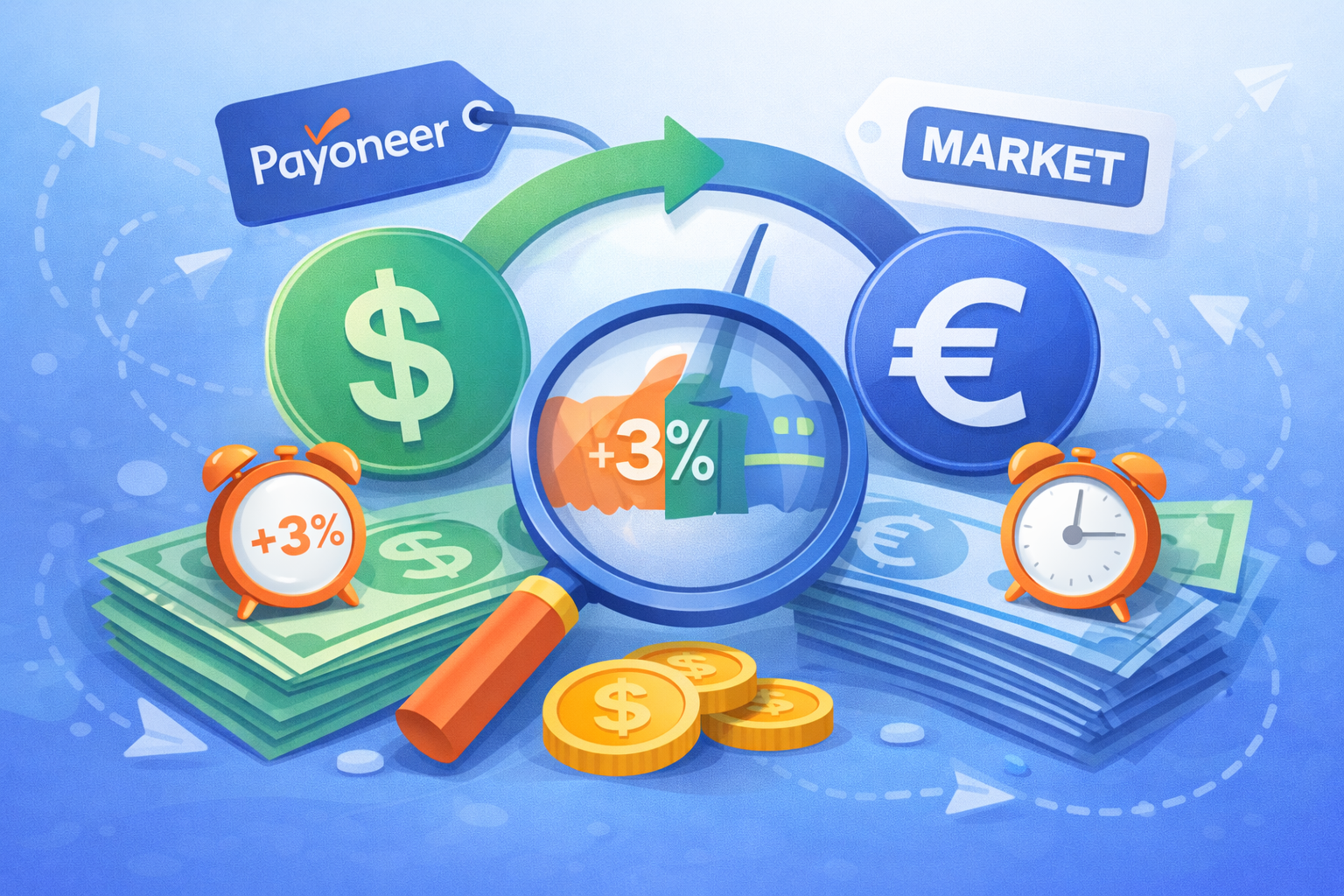
Payoneer applies a currency conversion markup on top of the base rate. This markup is typically around 2%–3%, though it can vary depending on the currency pair and account type.
That percentage may seem small — but over time it becomes significant.
Example: How much you lose in practice
Let’s say you receive $5,000 and withdraw it to a EUR bank account.
- Mid-market rate: 1 USD = 0.93 EUR
- Payoneer effective rate after markup: ~0.90–0.91 EUR
Difference per dollar: about 2–3 cents.
On $5,000, that’s roughly €100–€150 lost in a single transaction.
If you do this every month, you could lose over €1,200 per year — just from exchange rate spread.
Why exchange rate markup is more expensive than visible fees
Visible fees are predictable. Exchange rate markups scale with your income.
- The more you earn, the more you lose.
- High-volume freelancers are affected the most.
- It compounds over time.
This is why currency conversion is often the largest hidden cost of using global payment platforms.
When does Payoneer apply conversion?
Currency conversion happens when:
- You withdraw to a bank account in a different currency
- You use a Payoneer card in a foreign currency
- You transfer between currency balances (in some cases)
If you receive and withdraw in the same currency, you avoid this specific cost.
Is Payoneer worse than other platforms?
Not necessarily — but it depends on the alternative.
Some platforms apply similar or even higher markups. Others, like multi-currency fintech services, often provide rates much closer to the real market rate.
If transparent exchange rates are important for your business, you may want to compare Payoneer with services like
Wise,
which is known for showing the mid-market rate separately from its fee structure.
How to reduce exchange rate losses
- Withdraw in the same currency you receive
- Open a bank account in USD or EUR if possible
- Batch withdrawals instead of frequent small transfers
- Compare effective rates before converting
Small operational changes can significantly reduce long-term losses.
Should you stop using Payoneer?
Not necessarily.
Payoneer remains convenient for marketplace payouts and certain regions. But relying on it as your only international payment solution may not be optimal if exchange rate transparency is a priority.
Final thoughts
The Payoneer exchange rate is not “wrong” — it simply includes a markup.
The problem is that many freelancers never calculate the real impact of that markup.
If you work internationally and deal with currency conversion regularly, understanding exchange spreads is one of the most important financial skills you can develop.
Disclosure: This article may contain affiliate links. If you sign up through them, we may earn a commission at no additional cost to you. The information provided is for educational purposes only.
You may also find helpful our guides on minimizing payout fees and choosing the best international banking setup for freelancers.